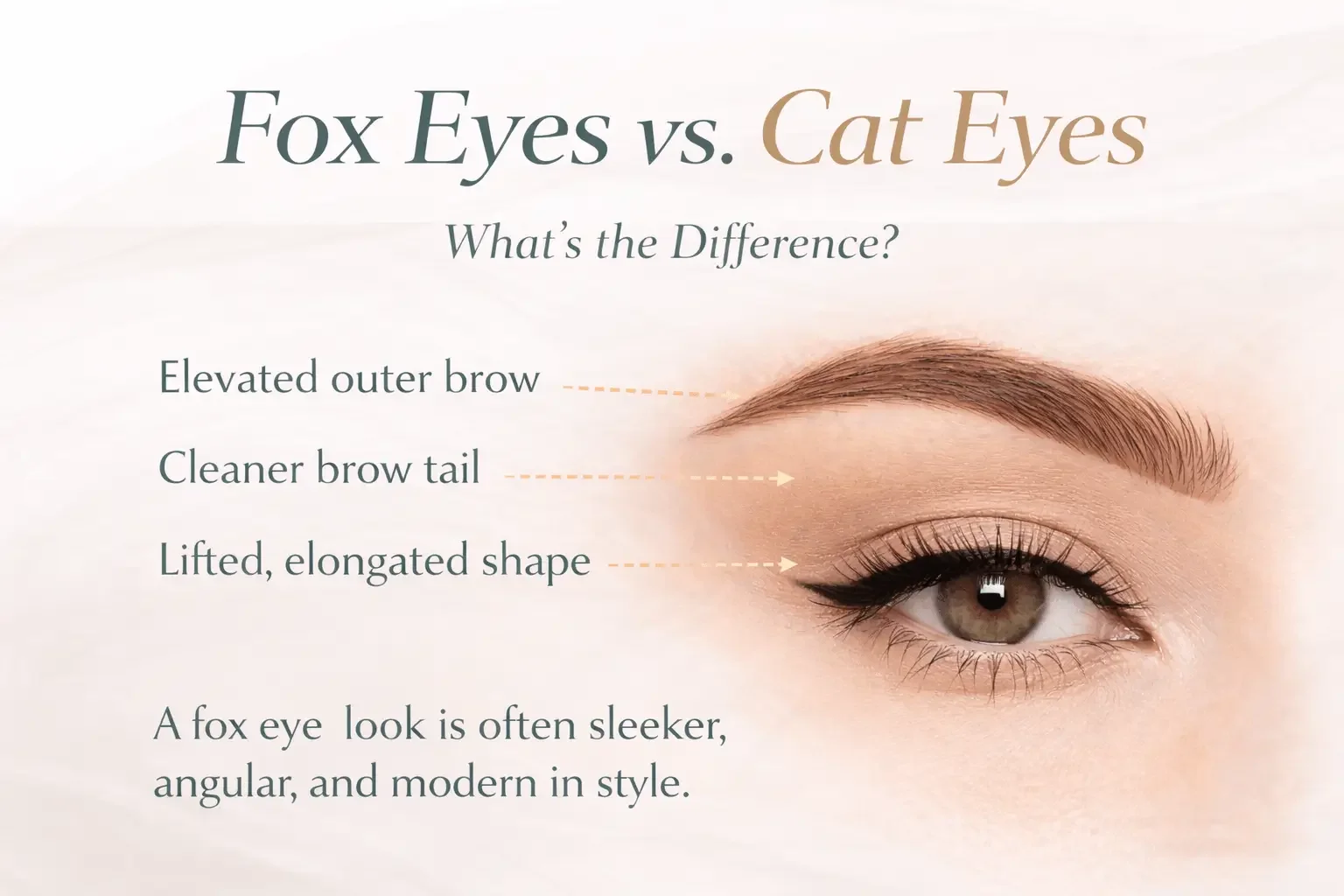
Fox Eyes vs. Cat Eyes: What’s the Difference?
Fox Eyes vs. Cat Eyes: Botox Brow Lift Differences?
Fox eyes and cat eyes are terms patients often use when describing a lifted, elongated look around the outer brow and upper eye area. Online, the phrases are sometimes used interchangeably. In real life, they are not standardized medical terms, and they do not describe one fixed Botox treatment plan.
The practical question is usually this: can cat eye or fox eye Botox help create a subtle brow lift or more refined eye-area shape without looking overdone?
At NeuroBeauty in Walnut Creek, this is approached conservatively. The goal is not to chase an internet trend. The goal is to understand the patient's anatomy, brow movement, eyelid heaviness, facial balance, and expectations before deciding whether Botox brow shaping is appropriate.
Quick Answer: Fox Eyes vs Cat Eyes
fox eye look usually refers to a more lifted, elongated, and slightly straighter outer brow and eye appearance. A cat eye look usually describes a lifted outer eye shape that may be a little softer, more curved, or more classic. Both are really trend-language ways of talking about brow-tail position, outer-eye lift, and upper-face balance.
Botox may help selected patients create a mild outer brow lift, but it cannot fully reshape the eye, remove loose skin, or reproduce the effect of surgery. The most medically responsible, natural-looking version is usually subtle.
Fox Eyes vs Cat Eyes: Simple Comparison
| Feature | Fox Eye Look | Cat Eye Look |
|---|---|---|
| General shape | More elongated and slightly sharper. | Lifted and elongated, often with a softer curve. |
| Brow focus | Often emphasizes the outer brow tail and a cleaner lateral lift. | Often emphasizes outer-eye flare and a lifted but less angular shape. |
| Overall effect | Sleeker, more sculpted, and more modern. | Classic, lifted, and slightly softer. |
| How Botox may help | May support a subtle lateral brow lift in the right anatomy. | May support mild outer brow refinement and eye-area opening. |
| Important limitation | Botox cannot create a surgical fox eye lift or change natural eye anatomy. | Botox cannot replace eyelid surgery, a surgical brow lift, or a thread lift. |
These Are Trend Terms, Not Medical Diagnoses
One reason this topic can be confusing is that "fox eyes" and "cat eyes" mean different things to different people. Some patients are describing makeup. Some are describing a brow shape. Some are thinking of thread lifts, surgery, or edited photos. Others are really asking whether Botox can create a small eyebrow lift.
That distinction matters. A trend term should not determine the treatment plan. At NeuroBeauty, the discussion starts with anatomy: how the brow moves, where the brow tail sits, whether the forehead muscle is compensating for heaviness, whether the upper eyelid has excess skin, and whether a small Botox change would look balanced.
How Botox May Create a Subtle Brow Lift
Botox works by relaxing selected muscles. Around the brow and eye area, small changes in muscle balance can sometimes allow the outer brow to sit slightly higher or look more refined.
This is the general idea behind a Botox brow lift or eye contour Botox treatment. It is not about freezing the face or using more product. It is about careful judgment, conservative dosing, and understanding the relationship between brow-lifting and brow-depressing muscles.
The American Society of Plastic Surgeons has also discussed the difference between Botox brow lift effects and surgical brow lift procedures, noting that Botox may create a nonsurgical, subtle lifting effect in selected patients but cannot structurally reposition tissue the way surgery can. You can read their overview of brow lifts vs Botox for additional background.
What Botox Can and Cannot Do
Botox may help with:
A subtle outer brow lift.
Mild refinement of the brow tail.
A more open-looking upper eye area in selected patients.
Improved upper-face balance.
Softening of dynamic lines around the forehead, frown lines, or crow's feet when appropriate.
Mild asymmetry when muscle movement is part of the issue.
Botox cannot:
Remove significant loose upper eyelid skin.
Replace blepharoplasty, surgical brow lift, or thread lift results.
Change the natural shape of the eye itself.
Create the same fox eye or cat eye effect in every patient.
Guarantee symmetry.
Safely force a trend look that does not fit the patient's anatomy.
This is why consultation matters. The right treatment depends on the relationship between the brow, forehead, eyelids, and surrounding facial structure.
Who May Be a Good Candidate?
Cat eye or fox eye Botox may be worth discussing if you want a subtle, natural-looking lift rather than a dramatic change.
It may be a reasonable option for patients who have:
Good brow mobility.
Mild heaviness near the outer brow.
A desire for subtle eye-area refinement.
Realistic expectations about small changes.
Interest in a non-surgical option.
A preference for conservative, anatomy-guided treatment.
A good candidate understands that the goal is refinement, not a dramatic new eye shape.
Who May Not Be a Good Candidate?
This treatment is not right for everyone. It may not be appropriate if:
There is significant upper eyelid skin heaviness.
The brow is already high or over-arched.
The forehead muscle is working hard to hold the brow up.
The desired result would require surgery or a thread lift rather than Botox.
Expectations are dramatic or based on edited social media images.
There is a medical reason Botox may not be appropriate.
In some patients, too much relaxation in the wrong area can make the brow feel heavier rather than lifted. This is one reason physician-performed treatment matters in the brow and eye area.
Why Hooded Eyes Require Careful Evaluation
Many people searching for fox eye Botox or cat eye Botox are really concerned about hooded eyes. Botox may help some patients with mild brow-related heaviness, but it does not remove excess eyelid skin.
If the heaviness is mostly due to skin, eyelid anatomy, or significant brow descent, Botox may provide little improvement or may not be the right treatment. In other patients, a conservative brow-shaping approach may help the eyes appear slightly more open. The difference depends on anatomy.
At NeuroBeauty, Dr. Sodeifi evaluates brow position, eyelid heaviness, forehead movement, facial symmetry, and goals before recommending treatment.
Why Physician Technique Matters Around the Eyes
The brow and upper eye area are among the most nuanced areas for cosmetic Botox. Small differences in planning can affect brow height, eyelid heaviness, symmetry, expression, and the overall shape of the upper face.
This is not an area where "more" is better. Over-treatment can make the brow look heavy, surprised, uneven, or unnatural. Under-treatment may not create enough visible change. The appropriate plan depends on anatomy, muscle strength, prior Botox history, and the patient's preferred level of subtlety.
At NeuroBeauty, all injectable treatments are performed by Dr. Negar Sodeifi, MD, with a conservative, physician-only approach focused on facial anatomy, safety, and natural-looking results.
Cat Eye and Fox Eye Botox in Walnut Creek
For patients in Walnut Creek, Lafayette, Pleasant Hill, Concord, Alamo, Danville, and the East Bay, the right version of this treatment is usually not an exaggerated trend look. It is a subtle brow and eye-area refinement that fits the face.
If you are considering cat eye or fox eye Botox in Walnut Creek, a consultation can help determine whether Botox brow shaping, eye contour Botox, another approach, or no treatment is the right choice. You can also review current Botox pricing before scheduling.
To discuss candidacy, schedule a consultation with NeuroBeauty or call the office at (925) 726-3876.
Or Call NeuroBeauty Clinic at (925) 726-3876 to learn more
Frequently Asked Questions (FAQ) About Fox Eyes and Cat Eyes Botox
-
Fox eyes usually refer to a more elongated, slightly sharper, lifted outer brow and eye appearance. Cat eyes are also lifted and elongated, but the look is often softer or more curved. In practice, many patients are describing some version of subtle outer brow lift.
-
They overlap, but they are not precise medical terms. Both usually refer to Botox brow shaping intended to create a subtle lifted or elongated look around the outer brow and upper eye area. The actual treatment plan should be based on anatomy, not the trend label.
-
In selected patients, Botox may help create a mild outer brow lift or more refined upper-eye appearance. It cannot fully change eye shape or create the same result in every patient.
-
Botox may create a subtle fox-eye-inspired effect in the right anatomy by adjusting muscle balance around the brow. It does not replace a surgical brow lift, thread lift, or eyelid surgery.
-
No. Botox may help selected patients with mild brow-position concerns, but it cannot remove skin, reposition tissue structurally, or reproduce surgical lifting. If the concern is significant skin laxity or eyelid heaviness, another option may be more appropriate.
-
Sometimes, but not always. If hooding is related to mild brow position, Botox may help the eye area appear slightly more open. If the issue is significant eyelid skin or structural heaviness, Botox may not be enough and could be the wrong approach.
-
Botox results are temporary. Many cosmetic Botox effects last around three to four months, although duration varies by patient, dose, treatment area, metabolism, and muscle activity.
-
There is no one-size-fits-all unit number. The right plan depends on brow anatomy, muscle strength, prior Botox history, asymmetry, and treatment goals. For safety, this should be determined during an in-person consultation rather than copied from an online injection map.
-
Possible risks include bruising, asymmetry, brow heaviness, eyelid heaviness, headache, an unnatural brow shape, or a result that is too subtle or not the desired shape. More serious reactions are uncommon but possible. A careful medical evaluation helps determine whether Botox is appropriate.
-
Often, the underlying concept is similar. "Fox eye" and "cat eye" are trend terms, while Botox brow lift is a more practical way to describe the treatment goal: a mild lift or refinement of brow position in selected patients.
Page details
Fox Eyes vs. Cat Eyes: What’s the Difference?
Compare fox eye vs cat eye Botox, brow lift limits, candidacy, and anatomy-guided treatment at NeuroBeauty in Walnut Creek.
Fox Eyes vs. Cat Eyes: What’s the Difference?
Compare fox eye vs cat eye Botox, brow lift limits, candidacy, and anatomy-guided treatment at NeuroBeauty in Walnut Creek.
Dr. Negar Sodeifi, MD, Physician and neurologist