

Is Sculptra a filler?
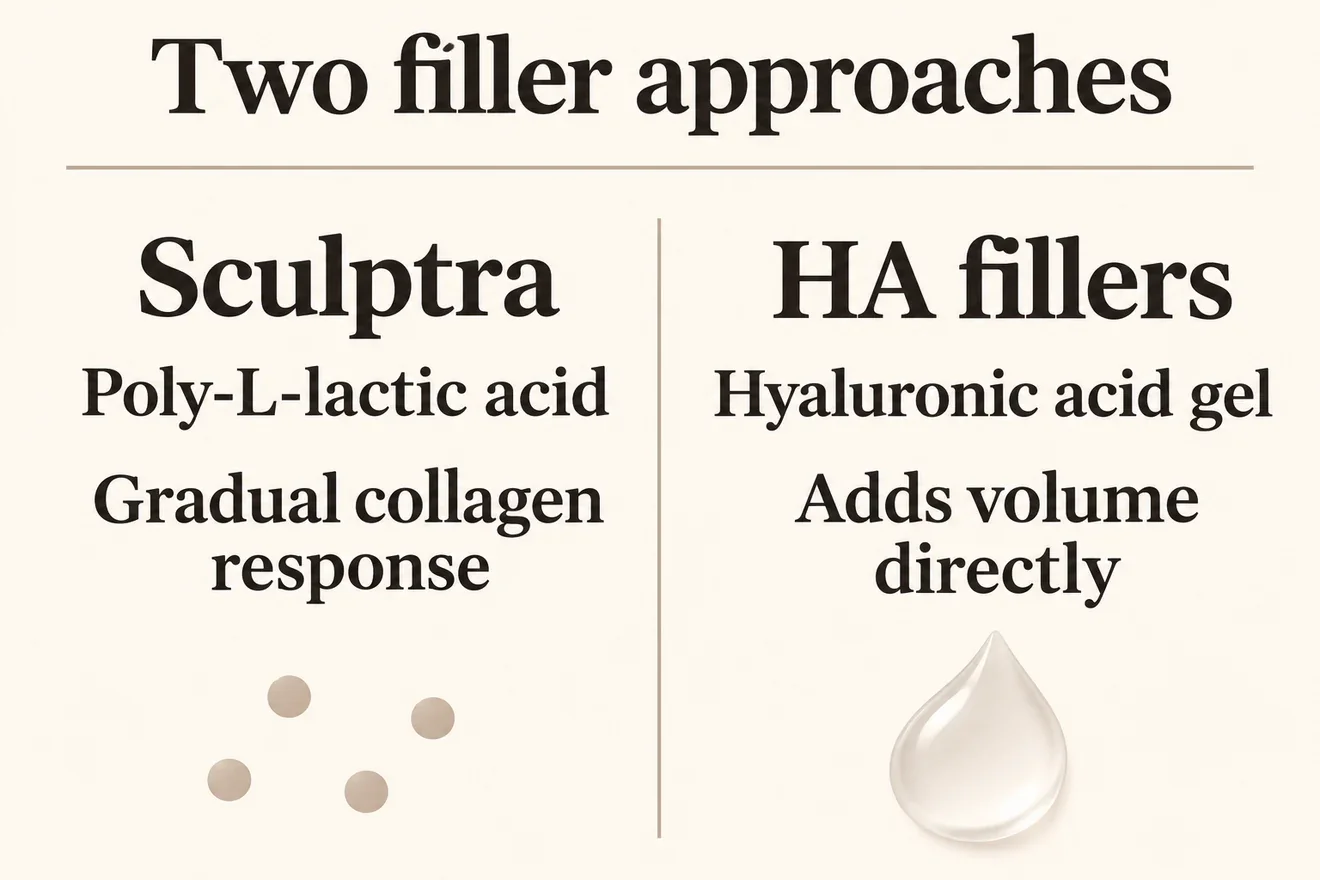
Sculptra is a dermal filler made with poly-L-lactic acid (PLLA). It stimulates a gradual collagen response. Hyaluronic acid (HA) fillers are gels that add volume or support where they’re placed. The choice depends on what you want to change, how soon you want to see a change, and how much flexibility you want afterward.
How are Sculptra and HA fillers different?
When you see a change. Sculptra’s effect develops over weeks. Some early fullness comes from fluid or swelling and can settle before the gradual change becomes visible. HA gel adds volume when it’s placed, and swelling can affect how it looks at first.
What each approach can do. Sculptra may suit someone whose goal is a gradual change in selected areas. A specific HA gel may suit a goal such as adding support or refining contour. The right product depends on the area and what’s causing the concern.
Can Sculptra or HA filler be dissolved? A clinician may use hyaluronidase to reduce some HA filler. This is an off-label use in the U.S., and the degree of correction varies. Hyaluronidase does not dissolve Sculptra.
How you plan for it. Discuss how many visits might be needed, when to judge progress, and what follow-up could involve. Sculptra may be planned as a series. For HA filler, the plan depends on the product, area, and amount needed.
Does Sculptra last longer?
There’s no single duration comparison that applies across HA products and treatment areas. Studies that compare PLLA and HA look at specific products, areas, and schedules. Ask what duration is realistic for your proposed treatment and how you’ll decide whether to wait, reassess, or consider more treatment.
What are the risks?
Either treatment can cause swelling, bruising, tenderness, or redness. Lumps or nodules can develop, sometimes later. Infection is also possible. In rare cases, filler can enter a blood vessel and cause serious harm, including skin injury, vision loss, or stroke.
Seek emergency medical care right away if you develop unusual pain, vision changes, white, gray, or blue skin near the injection site, or symptoms of a stroke during or shortly after treatment. The FDA’s dermal filler safety guide explains these warning signs.
Before choosing a filler, tell your physician about prior facial procedures or filler, allergies, relevant medications, and any history of raised scars. Sculptra labeling lists a history of, or susceptibility to, keloids or hypertrophic scars among its reasons to avoid treatment.
Questions to bring to your consultation
Could either option help with cheek changes or smile lines?
The exact concern matters. Cheek lines, loss of cheek support, and folds beside the mouth can call for different plans. The Sculptra service page and dermal filler guide explain the approaches available at NeuroBeauty. A consultation can help clarify whether either fits your anatomy and goals.
Can I consider Sculptra if I’ve already had HA filler?
Possibly. Bring the product name, dates, and areas treated if you have them. Your physician can review what was placed and where, then discuss whether a staged plan, more time, or another approach makes sense.
Which costs more, Sculptra or HA filler?
The total cost depends on the product, how much is needed, and how many visits are planned. Ask for an estimate for the full plan, including any follow-up or maintenance. The dermal filler price list gives published estimates for listed treatments. Ask for a separate estimate for your proposed Sculptra course.
Discuss your options in Walnut Creek
At NeuroBeauty, Dr. Negar Sodeifi, MD performs consultations and treatments. Bring one or two things you’d like to change and tell her what you’d like to preserve. Schedule a consultation online to discuss what fits your goals.
Further reading
Page details
Sculptra vs. Hyaluronic Acid Fillers
Compare Sculptra and hyaluronic acid fillers by how they work, when results develop, what can be adjusted, and which risks to discuss at a consultation.