
Chin Dimpling (Mentalis) Botox in Walnut Creek
Chin Botox, also called mentalis Botox, may soften selected patterns of active chin dimpling, puckering, or an "orange-peel" texture. The treatment is most relevant when the uneven texture becomes more noticeable as the mentalis muscle contracts during smiling, speaking, pursing the lips, or closing the mouth.
At NeuroBeauty in Walnut Creek, every consultation and treatment is performed by Dr. Negar Sodeifi, MD, a neurologist. Because the mentalis sits close to muscles that control the lower lip, treatment is planned conservatively around facial movement, lip closure, smile balance, and chin structure.
Schedule a consultation online or review current Botox pricing.

What Causes an Orange-Peel or Cobblestone Chin?
The mentalis is a paired muscle in the center of the chin. It helps raise the soft tissue of the chin and contributes to lower-lip movement. Because some mentalis fibers attach close to the skin, strong contraction can create multiple small dimples, rippling, bunching, or a pebbled surface.
Patients may describe this appearance as:
Orange-peel chin or peau d'orange chin
Cobblestone or pebbled chin
A puckered or tense-looking chin
Chin dimpling while smiling or speaking
Bunching when the lips close
These descriptions are useful, but they do not identify the cause by themselves. Skin laxity, collagen loss, scarring, a deep crease below the lower lip, soft-tissue changes, and chin structure can also affect surface texture. Dr. Sodeifi evaluates the chin both at rest and during movement before deciding whether muscle activity is a meaningful contributor.
How Mentalis Botox May Help
Botox reduces selected nerve signals to the treated muscle. When carefully placed in the mentalis, it may decrease excessive contraction and soften the skin bunching that appears with movement.
The goal is partial relaxation, not complete paralysis. A thoughtful result should preserve normal expression and lower-face function while reducing the movement that creates the unwanted texture. The degree of improvement varies with anatomy, muscle strength, skin quality, baseline asymmetry, and whether the dimpling is primarily dynamic or remains visible at rest.
Botox does not resurface the skin, add volume, or rebuild the chin. If the concern is mainly structural or fixed, another treatment may be more appropriate.
Dynamic Dimpling vs. Static Chin Texture
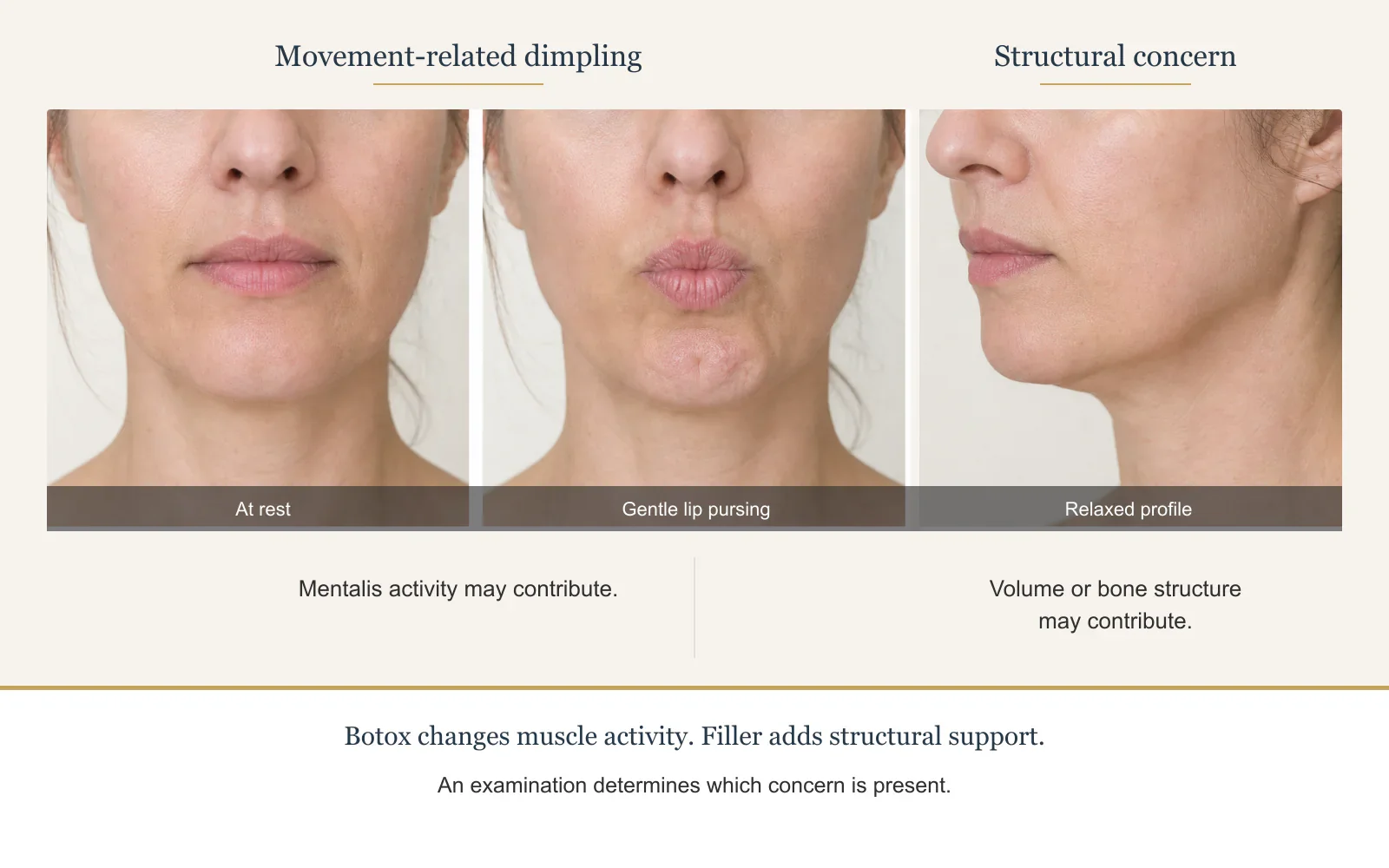
Botox is most likely to be relevant when dimpling becomes more visible as the chin moves. A chin that looks smoother at rest but puckers during speech, smiling, or lip closure suggests a stronger dynamic component.
Texture that remains prominent while the face is fully relaxed may be multifactorial. Skin quality, collagen loss, soft-tissue support, a recessed chin, scarring, or a pronounced labiomental crease may contribute. Botox may soften the muscular part of the concern, but it cannot be expected to correct every source of uneven texture.
This distinction is one reason an in-person movement assessment matters.
Chin Botox vs. Chin Filler
Chin Botox and chin filler treat different problems.
Chin Botox changes selected mentalis muscle activity. It may be appropriate when active contraction creates dimpling, puckering, or upward bunching.
Chin filler adds structural support or projection. It may be considered when the primary concern is a recessed or under-projected chin, contour, proportion, or volume-related asymmetry.
Some patients have both mentalis overactivity and a structural chin concern. Others need only one approach, and some are better served by no injectable treatment. Botox should not be presented as a reliable way to lengthen or project every chin, and filler does not directly stop an overactive muscle.
Who May Be a Good Candidate?
Mentalis Botox may be considered for an adult who:
Has multiple small chin dimples or puckering that increase with movement
Notices chin bunching while speaking, smiling, pursing, or closing the lips
Has a tense or overactive mentalis pattern on examination
Wants softening rather than a dramatic change in chin shape
Understands that the result is temporary and variable
Accepts the functional risks of lower-face Botox
Candidacy cannot be determined from a photograph alone. Dr. Sodeifi reviews the chin at rest and in motion, baseline lower-lip control, oral competence, facial asymmetry, medical history, prior treatment, and the patient's goals.
When Botox May Not Be the Best Fit
Botox may not address the main concern when:
The texture is fixed and does not change with facial movement
The primary goal is greater chin projection or structural reshaping
The concern is a single inherited cleft chin rather than surface dimpling
Submental fullness or a "double chin" is the main issue
Baseline lower-lip weakness, limited lip closure, or significant asymmetry raises functional concern
A skin condition, infection, scar, dental issue, or skeletal factor needs a different evaluation
The expected change exceeds what temporary muscle relaxation can provide
Treatment may also be inappropriate or deferred based on medical history, medications, neuromuscular conditions, pregnancy, breastfeeding, infection at the treatment site, or prior response to botulinum toxin. These factors are reviewed during consultation.
What to Expect From Treatment
Dr. Sodeifi first observes the chin at rest and during facial movement. If Botox is appropriate, she selects a conservative pattern based on mentalis activity, chin anatomy, asymmetry, and lower-lip function.
The injections are brief. Temporary redness, tenderness, swelling, or bruising can occur at the injection sites. Many patients return to routine activities the same day, although individual aftercare guidance should be followed.
The effect is gradual rather than immediate. Some change may become noticeable within several days, with the treatment more fully assessed at about two weeks. Results often last approximately three to four months, but onset, degree of improvement, and duration vary.
Risks, Limitations, and Off-Label Use
Using Botox in the mentalis for cosmetic chin dimpling is off-label. The current FDA BOTOX Cosmetic prescribing information lists approved cosmetic treatment areas, but the mentalis or chin is not among them. Physicians may use an approved medication off-label when they judge it appropriate and discuss the expected benefits, limitations, alternatives, and risks.
Possible effects include:
Redness, swelling, tenderness, or bruising
Incomplete or uneven softening
Temporary lower-lip weakness or asymmetry
A change in the smile or lower-lip position
Difficulty with lip closure or containing liquids
Changes in speech or mouth movement
Paradoxical or uneven chin bulging if part of the muscle remains more active
An unwanted result that cannot be immediately reversed and must diminish over time
Botulinum toxin products also carry rare but serious warnings about spread of toxin effect, including speaking, swallowing, or breathing difficulty. Patients should receive individualized safety counseling and know when urgent medical attention is needed.
A peer-reviewed review of mentalis anatomy and Botox treatment describes why precise localization matters: spread into nearby lower-lip muscles may contribute to mouth-closure difficulty, lower-lip droop, or smile asymmetry.
Why Choose Physician-Performed Chin Botox?
The mentalis is a small muscle with an important functional role. The relevant question is not simply where dimples appear. It is which movement is producing them, how much activity should remain, and whether weakening the muscle could affect the lower lip or mouth.
At NeuroBeauty, treatment is not delegated to an NP, PA, nurse injector, esthetician, or technician. Dr. Sodeifi personally evaluates facial movement, determines candidacy, explains alternatives, and performs every injection. Her neurologic background is especially relevant to a treatment based on neuromuscular function and precise lower-face anatomy.
Learn more about NeuroBeauty's approach to cosmetic Botox in Walnut Creek.
Chin Dimpling Botox Pricing
NeuroBeauty currently lists cosmetic Botox at $14 per unit. The number of units needed for the mentalis is individualized and cannot be determined safely from a generic online formula. Final cost depends on anatomy, muscle strength, asymmetry, prior treatment, and the recommended plan.
The consultation fee is $50 and is credited toward treatment when treatment is performed the same day. Review current Botox pricing for the latest information.
Related Treatments
Frequently Asked Questions (FAQ) About Chin Botox
-
No. An orange-peel or cobblestone chin usually describes multiple small dimples or a pebbled texture that may change with movement. A cleft chin is generally a single inherited central indentation. Botox does not remove an inherited cleft.
-
No. It is most relevant when excessive mentalis contraction is an important contributor. Static texture, scarring, skin laxity, volume loss, and structural chin concerns may respond differently or require another approach.
-
Botox changes muscle activity rather than adding structure. It may alter soft-tissue position in selected patients, but greater projection or length should not be promised. Chin filler addresses structural support more directly.
-
Yes. The mentalis is close to muscles that control the lower lip. Excessive weakening or unintended spread may temporarily affect smile symmetry, lip position, speech, or lip closure. Conservative, anatomy-guided treatment reduces but does not eliminate these risks.
-
The effect develops gradually. Some change may appear within several days, and the result is usually assessed more fully at about two weeks.
-
Results often last approximately three to four months, but duration varies with dose, muscle activity, product, metabolism, and individual response.
-
No. BOTOX Cosmetic is FDA-approved for specific cosmetic treatment areas, but cosmetic use in the mentalis or chin is off-label.
-
There is no single unit count appropriate for every patient, and units are not interchangeable among different botulinum toxin products. Dr. Sodeifi determines the treatment plan after examining muscle strength, movement, asymmetry, and lower-lip function.
Schedule Chin Botox in Walnut Creek
NeuroBeauty serves patients from Walnut Creek, Lafayette, Pleasant Hill, Concord, Alamo, Danville, Orinda, and the greater East Bay. A consultation can clarify whether your chin texture appears primarily muscle-driven and whether mentalis Botox, chin filler, another approach, or no procedure is the better fit.
Page details
Chin Dimpling (Mentalis) Botox in Walnut Creek
Physician-performed mentalis Botox for selected patterns of active chin dimpling or orange-peel texture in Walnut Creek, with conservative candidacy assessment and realistic treatment limits.
Chin Dimpling (Mentalis) Botox
An off-label cosmetic Botox treatment intended to soften selected patterns of active chin dimpling associated with mentalis muscle contraction.
NeuroBeauty
323 Lennon Lane, Walnut Creek, CA 94598
Phone: (925) 726-3876
Treatment performed by Dr. Negar Sodeifi, MD