

Dysport and Botox are different prescription botulinum toxin products that can temporarily soften selected expression lines. Both can be reasonable options, but neither is the best choice for every face. The useful comparison is the treatment area, medical history, response to past treatment and overall plan—not the number of units on a receipt.
At NeuroBeauty in Walnut Creek, consultations and treatments are performed by Dr. Negar Sodeifi, MD, a neurologist. If you are comparing these options, start with what you want to soften and what you want to preserve, including your expression.
What do Dysport and Botox have in common?
Both reduce activity in the muscles treated. This can soften lines associated with repeated facial movement, such as frowning. They do not add facial volume like dermal fillers, and relaxing a muscle will not address every cause of a crease or change in skin texture.
Botox is often used casually as a name for all wrinkle-relaxing injections. Here, Botox means BOTOX Cosmetic, the onabotulinumtoxinA product. Dysport contains abobotulinumtoxinA. These names refer to distinct medicines, with their own labeling and unit measurements.
The differences that matter
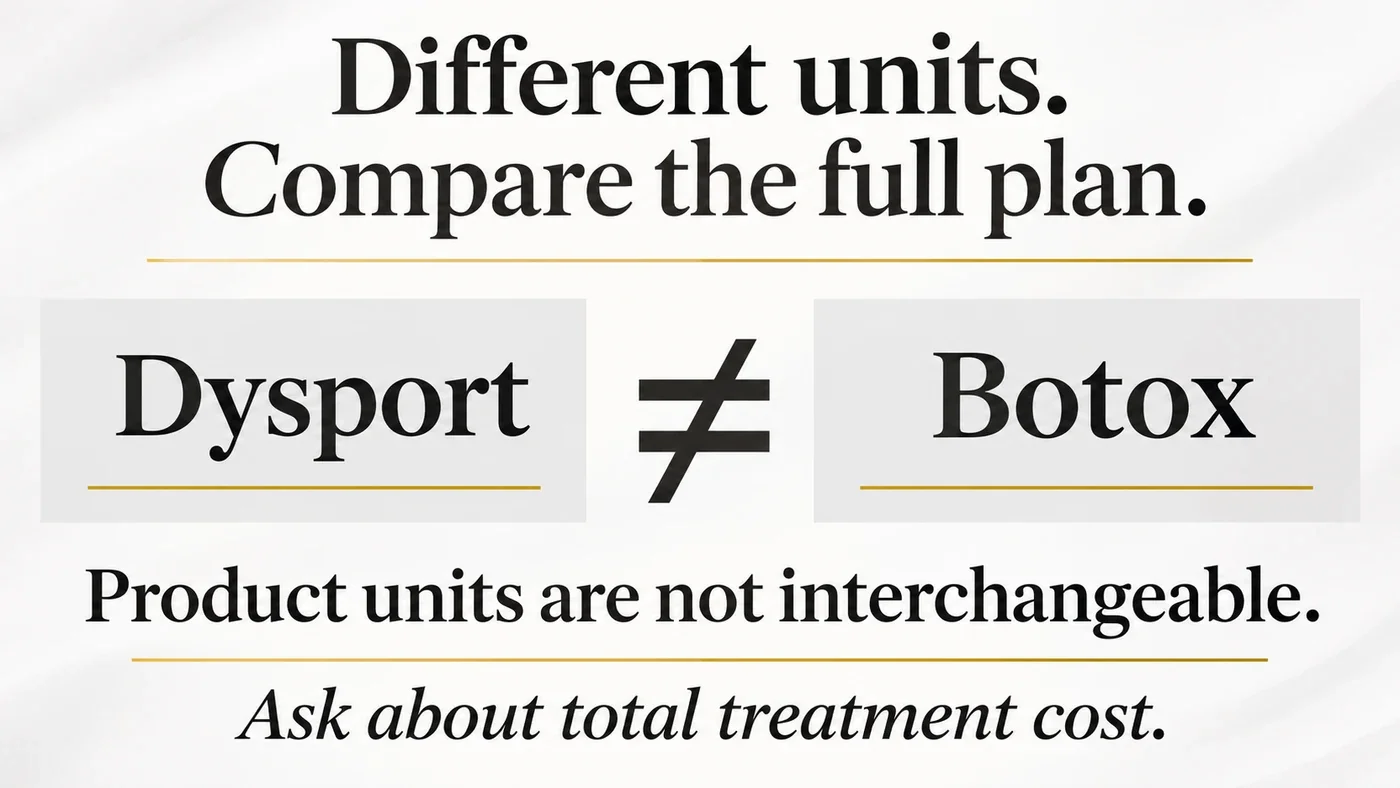
Units: Each product has its own potency measurement. A Dysport unit is not a Botox unit. Their numbers cannot be compared directly or exchanged using a universal conversion rule.
Approved cosmetic uses: U.S. approvals differ. BOTOX Cosmetic labeling includes selected glabellar, forehead, crow's feet and platysma-band indications in adults. Dysport's U.S. cosmetic indication is moderate to severe glabellar lines—the frown lines between the eyebrows—in adults younger than 65. Treatment outside a product's approved indication is off-label and needs its own clinical discussion.
Timing: Early changes and the point at which a result is assessed are different things. Neither brand provides an identical onset or duration for everyone.
Cost: A lower advertised price per unit does not establish a lower total treatment cost. Compare a plan for the same concern, with the product, treatment area and follow-up clearly explained.
Allergies: Product ingredients and contraindications matter. Dysport specifically lists allergy to cow's milk protein; this is different from lactose intolerance.
The BOTOX Cosmetic prescribing information and Dysport prescribing information describe the product-specific indications, precautions and contraindications.
Does Dysport work faster or last longer?
You may notice a change before the full effect is assessed. An advertisement describing the first visible improvement does not necessarily describe when your own result will be ready to judge or how long it will last.
For a concrete example, the BOTOX Cosmetic label describes the muscle effect beginning in about one to two days and increasing during the first week, with an approximately three- to four-month effect for glabellar lines. The Dysport label states that its glabellar-line effect may last up to four months. These are product- and area-specific descriptions, not a guaranteed personal timeline or proof that one lasts longer. Early muscle effects are not the same as your final visible result; agree on a reassessment time with your physician.
Head-to-head research does not establish one universal winner. Studies use different treatment areas, doses, assessment methods and patient groups. Some favor one product on a particular measure; others find similar results. For example, a randomized split-face study found no significant difference under its specific upper-face treatment protocol. That does not prove that every dose, area or patient will respond identically.
Ask your physician when to assess your proposed treatment, what variability to expect and when a follow-up would be appropriate. If you have an event coming up, discuss it before booking treatment rather than relying on a brand's fastest advertised response.
Why the unit numbers cannot tell you which is cheaper
Product units are not interchangeable. A larger number on a Dysport plan does not, by itself, mean stronger treatment or overtreatment; a smaller Botox number does not establish better value. There is no patient-use conversion calculator that can safely replace a physician's product-specific plan.
For a useful estimate, ask which areas are included, what product will be used, the total treatment cost and how follow-up is handled. Compare the full plan rather than multiplying one brand's units by the other brand's price.
See NeuroBeauty's current Botox pricing for published information, and ask for an estimate for the specific product and areas proposed for you. A seasonal offer or an old online price may not describe a future visit.
Is one better for forehead lines or the “11s”?
The “11s” usually means the vertical frown lines between the eyebrows. These are different from horizontal forehead lines or crow's feet beside the eyes. Treating one area may also require consideration of nearby muscles and brow position.
Product approval is one part of that conversation; it does not replace assessment of your anatomy. Ask which product is being recommended for which area, whether that use is on-label or off-label and why it fits your goals. Do not assume that an approval or result for one facial area applies to every other area.
Our frown-line treatment page explains the concern in more detail. The cosmetic Botox guide covers the broader consultation and treatment approach.
Risks and candidacy come before brand preference
Both products can cause side effects. These can include injection-site discomfort or bruising, headache, unwanted weakness, drooping or asymmetry; the pattern depends partly on the product and area treated. Neither product is risk-free, and having a physician perform treatment does not eliminate the possibility of a complication.
Both carry a boxed warning about toxin effects spreading beyond the injection area. Get emergency medical help right away if you develop trouble swallowing, speaking or breathing after treatment. Tell the treating clinician which product you received and when.
Before treatment, discuss previous botulinum toxin injections, reactions, infection at the proposed injection site, medications, neuromuscular conditions and any swallowing or breathing problems. Pregnancy or breastfeeding also needs discussion. A consultation may lead to postponing treatment or recommending another approach.
For Dysport, a history of cow's milk protein allergy specifically matters. Lactose intolerance is not the same condition, but it is not a reason to determine candidacy yourself. Explain the reaction or diagnosis to your physician.
What if you want to switch products?
Bring the product name, treatment date, areas treated and dose records if available. Describe what you liked, what you would change and when any unwanted effects appeared. Switching brands does not automatically solve an unsatisfactory result: placement, anatomy, timing, expectations and the original plan may also matter.
Your physician can decide whether to wait, adjust a future plan or consider a different approach. Do not use online unit ratios to plan a switch or seek additional injections before your previous treatment has been assessed.
Frequently asked questions about Botox vs Dysport
-
Neither brand guarantees a natural-looking result. The desired amount of movement, the muscles treated, anatomy and the treatment plan all matter. Tell your physician which expressions you want to preserve rather than choosing a brand from a photograph alone.
-
Either treatment can cause brief discomfort at the injection site. How it feels varies by person and by treatment area, and some tenderness or bruising can occur afterward. If you plan to return to work or exercise that day, ask before treatment whether you should adjust your plans. Follow the aftercare instructions for your treatment.
-
They do different jobs. Muscle-relaxing treatment may help selected expression lines; dermal filler can address selected volume or contour concerns. Neither approach is appropriate for every line. A consultation can help distinguish muscle movement, skin changes and loss of support.
-
No. Cosmetic facial-line treatment and therapeutic indications have different goals and evidence. Do not infer that Dysport has the BOTOX indication for chronic migraine. Start with NeuroBeauty's therapeutic Botox information if headache or another medical concern is your reason for seeking care.
-
No. Unit prices and unit counts are product-specific. Request a total estimate for the same concern, including the planned areas and follow-up, before comparing offers.
-
Discuss the date in advance. Allow room for the response to develop, possible bruising or swelling and any appropriate reassessment. A first treatment is not a reliable last-minute experiment, and no appointment can guarantee a particular appearance by an event date.
Discuss your options in Walnut Creek
NeuroBeauty offers Botox and Dysport with physician-performed consultations and treatment. Dr. Negar Sodeifi, MD can assess the concern, review relevant medical history and discuss whether either product fits your goals. The goal is a thoughtful plan, not winning a brand comparison.
Schedule a consultation online to discuss your options.
This article provides general education and does not replace an individual medical assessment.
Page details
Dysport vs Botox: Differences, Timing and Cost
Compare Dysport and Botox by units, timing, cost, approved uses and risks. Learn what to ask at a physician consultation in Walnut Creek.