
Botox for Neck and Shoulder Muscle Tension in Walnut Creek
Chronic neck and shoulder tension can come from many different causes, including muscle overactivity, posture, stress-related clenching, headache patterns, cervical spine conditions, neurologic disorders, or myofascial pain.
In selected patients, therapeutic Botox may be considered when overactive neck or shoulder muscles appear to be contributing to persistent tightness, spasm, discomfort, or headache-related muscle tension.
At NeuroBeauty Clinic in Walnut Creek, Botox for neck and shoulder muscle tension is performed exclusively by Dr. Negar Sodeifi, MD, a neurologist. Treatment is guided by muscle anatomy, symptom pattern, neurologic history, posture, movement, pain distribution, and whether Botox is appropriate for the specific cause of symptoms.
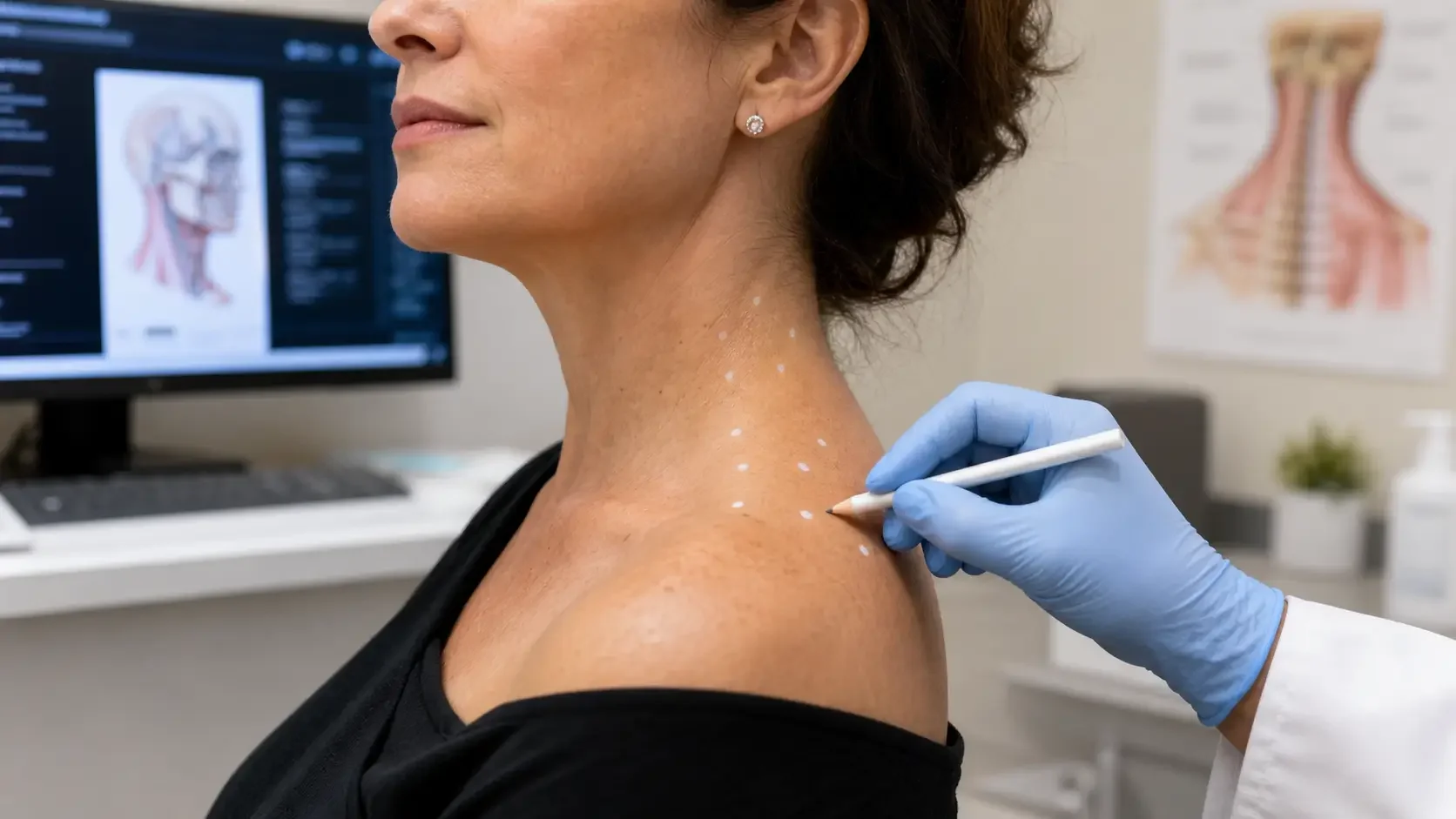
Neurologist-guided approach to neck and shoulder symptoms
Neck and shoulder pain should not be treated with a generic injection pattern. The first question is not “Where should Botox go?” The first question is: what is causing the symptoms?
Some patients have muscle-driven pain or spasm. Others have cervical spine disease, nerve irritation, migraine, cervical dystonia, TMJ-related tension, myofascial pain, posture-related strain, inflammatory conditions, or overlapping causes.
Dr. Sodeifievaluates the pattern before recommending treatment. The goal is to identify whether Botox is medically reasonable, which muscles are involved, and whether another treatment approach may be more appropriate.
What neck and shoulder Botox may help with
Botox may be considered for selected patients with symptoms related to excessive muscle activity or persistent muscle tension.
It may help selected patients with:
Neck muscle tightness
Shoulder muscle tension
Trapezius overactivity
Muscle spasm
Muscle-related discomfort
Headache patterns associated with neck and shoulder tension
Persistent tightness despite conservative care
Symptoms related to muscle overuse or abnormal muscle activation
Results vary. Botox does not treat every cause of neck or shoulder pain, and it is not a substitute for appropriate evaluation when symptoms suggest a spine, nerve, inflammatory, or structural problem.
Neck and shoulder Botox vs. cervical dystonia Botox
Neck and shoulder Botox focuses on selected muscle tension, spasm, or overactivity patterns involving areas such as the trapezius or cervical muscles.
Cervical dystonia Botox is for a neurologic movement disorder that causes involuntary neck muscle contractions, abnormal head posture, pulling, twisting, or dystonic movement.
There can be overlap in the muscles treated, but the diagnosis, treatment goals, dosing, and medical reasoning are different.
Neck and shoulder Botox vs. migraine Botox
Neck and shoulder tension can overlap with headache symptoms, but this is not the same as the standard chronic migraine Botox protocol.
Chronic migraine Botox follows a medical migraine-prevention pattern across the head and neck.
Neck and shoulder Botox is more focused on selected muscles that may be contributing to tension, spasm, or discomfort.
If headaches are a major concern, Dr. Sodeifi may evaluate whether the pattern is chronic migraine, tension-type headache, cervicogenic headache, TMJ-related headache, cervical dystonia, or another condition.
Who may be a good candidate
Neck and shoulder Botox may be appropriate for selected patients whose symptoms appear related to persistent muscle overactivity or spasm.
It may be a good fit for patients who:
Have chronic neck or shoulder muscle tightness
Have trapezius or cervical muscle overactivity
Have muscle spasm or persistent tension
Have headache patterns associated with neck and shoulder muscle tension
Have tried conservative strategies without adequate relief
Want treatment performed by a neurologist
Understand that results vary and candidacy depends on diagnosis
Candidacy is determined during consultation based on symptoms, exam findings, medical history, prior treatment response, muscle pattern, and safety considerations.
Who may not be a good candidate
Therapeutic Botox may not be appropriate for every patient with neck or shoulder pain.
It may not be the right treatment if symptoms are primarily caused by:
Cervical disc disease
Cervical radiculopathy
Spinal stenosis
Arthritis
Shoulder joint pathology
Rotator cuff disease
Inflammatory disease
Acute injury
Infection
Unexplained neurologic symptoms
Generalized pain syndromes without a clear muscle-overactivity target
Therapeutic Botox may also not be appropriate for patients with certain neuromuscular disorders, swallowing or breathing concerns, allergy to botulinum toxin ingredients, active infection at the treatment site, or other risk factors.
Pricing
Pricing for neck and shoulder Botox depends on diagnosis, muscles treated, dose, treatment complexity, and individualized plan.
Therapeutic Botox at NeuroBeauty Clinic is self-pay. Consultation or referral may be required to determine candidacy and expected benefit.
Please contact the office at (925) 726-3876 for current therapeutic Botox pricing.
How Botox works for neck and shoulder muscle tension
Botox temporarily reduces excessive muscle contraction by blocking nerve signaling at targeted muscles. When used in selected neck or shoulder muscles, it may reduce muscle overactivity and help decrease tension or spasm.
Treatment planning may consider muscles such as:
Trapezius
Sternocleidomastoid
Levator scapulae
Splenius muscles
Semispinalis muscles
Other cervical or shoulder-region muscles depending on the pattern
The goal is not to weaken the neck or shoulders broadly. The goal is careful, conservative reduction of overactivity in specific muscles when clinically appropriate.
What neck and shoulder Botox cannot do
Therapeutic Botox cannot correct posture by itself, repair spine disease, treat nerve compression, heal a shoulder injury, replace physical therapy, cure chronic pain, or guarantee symptom relief.
It may reduce muscle overactivity in selected patients, but it should be used only when the pattern suggests it is medically reasonable.
What to expect
Your visit begins with a focused review of symptoms, pain pattern, posture, muscle involvement, headache history, neurologic history, and prior treatment response.
Dr. Sodeifi evaluates whether the symptoms appear muscle-driven and whether Botox is appropriate. If treatment is recommended, the injection pattern is individualized based on the specific muscles involved and the treatment goal.
Some patients begin noticing change within several days, with fuller effect often developing over 1–2 weeks. Duration varies, but therapeutic Botox effects commonly last around 3 months.
Evidence and realistic expectations
For general neck and shoulder myofascial pain, the evidence for botulinum toxin is mixed. Some studies suggest benefit in selected patients, while others do not show clear superiority over placebo or standard approaches. Botox may be considered when the symptoms appear muscle-driven and when the expected benefit outweighs the risk of unwanted weakness. This is not a “one-size-fits-all” pain treatment.
Conservative care still matters
For many patients, conservative care remains important. Depending on the cause of symptoms, this may include physical therapy, stretching, ergonomic changes, posture work, strengthening, heat, anti-inflammatory medication when appropriate, massage, trigger-point strategies, migraine management, TMJ treatment, or evaluation for cervical spine disease.
Botox may be considered as part of a broader plan when muscle overactivity appears to be a significant contributor.
Safety considerations
Neck and shoulder Botox requires careful dosing because these muscles support posture, movement, head position, and shoulder function.
Possible side effects may include:
Injection-site discomfort
Bruising or tenderness
Temporary neck weakness
Shoulder weakness
Head heaviness
Soreness
Reduced ability to lift or stabilize the shoulder
Swallowing difficulty, depending on muscles treated
Incomplete response
Rare systemic botulinum toxin effects can occur, including generalized weakness, swallowing difficulty, breathing difficulty, or other distant spread symptoms. Patients with preexisting swallowing, breathing, or neuromuscular problems may require extra caution.
Related treatments
Patients considering neck and shoulder Botox may also be interested in:
Nefertiti Lift / Neck Bands Botox, if the concern is cosmetic neck contour rather than pain or muscle tension
The best plan depends on diagnosis, muscle pattern, pain distribution, neurologic history, and treatment goals.
Frequently Asked Questions (FAQ) About Botox For Neck and Shoulder Pain
-
It may help selected patients when neck or shoulder discomfort is related to muscle overactivity, spasm, or persistent muscle tension. It is not the right treatment for every cause of neck or shoulder pain.
-
Botox is approved for several neurologic and therapeutic indications, including cervical dystonia and chronic migraine, but Botox for nonspecific neck and shoulder muscle tension or myofascial pain is generally considered individualized/off-label treatment.
-
No. Cervical dystonia is a neurologic movement disorder involving involuntary neck muscle contractions and abnormal head posture. Neck and shoulder Botox is broader and should be used only when the symptoms appear related to selected muscle overactivity or spasm.
-
No. Chronic migraine Botox follows a specific migraine-prevention protocol. Neck and shoulder Botox is focused on selected muscles that may be contributing to tension, spasm, or discomfort.
-
Duration varies, but therapeutic Botox effects commonly last around 3 months. Repeat treatment timing depends on response, diagnosis, dose, and safety considerations.
-
Temporary weakness is possible, especially if dosing is too high or the wrong muscles are treated. That is why dosing and muscle selection should be conservative and anatomy-guided.
-
Possibly. Botox does not replace physical therapy, strengthening, posture work, or evaluation for structural problems when those are appropriate. In many patients, Botox is best considered as part of a broader plan.
-
Possible risks include bruising, soreness, neck weakness, shoulder weakness, head heaviness, swallowing difficulty, incomplete response, and rare systemic botulinum toxin effects.
-
Some insurance plans cover Botox for certain therapeutic indications, but NeuroBeauty Clinic does not bill insurance for these services. Therapeutic Botox at this location is self-pay.
-
The muscles depend on the symptom pattern. Treatment may involve the trapezius, sternocleidomastoid, levator scapulae, splenius, semispinalis, or other cervical/shoulder-region muscles when appropriate.
Schedule a consultation
NeuroBeauty is located in Walnut Creek, California, and serves patients from Lafayette, Danville, Alamo, San Ramon, Pleasant Hill, Concord, and the greater East Bay. If you are considering Botox for neck and shoulder muscle tension in Walnut Creek, NeuroBeauty Clinic offers neurologist-performed evaluation and treatment planning focused on anatomy, diagnosis, safety, and individualized care.
Call (925) 726-3876 or request a consultation online, and the office will contact you directly to discuss availability and next steps.
Page details
Botox for Neck and Shoulder Muscle Tension in Walnut Creek
Neurologist-performed Botox for selected neck and shoulder muscle tension or spasm in Walnut Creek. Physician-led evaluation and individualized treatment planning.
Neck and Shoulder Botox in Walnut Creek
Neurologist-performed Botox for selected neck and shoulder muscle tension or spasm in Walnut Creek. Physician-led evaluation and individualized treatment planning.